How to Buy Land in Clarksville, TN and Build a Home
Sep 01, 2026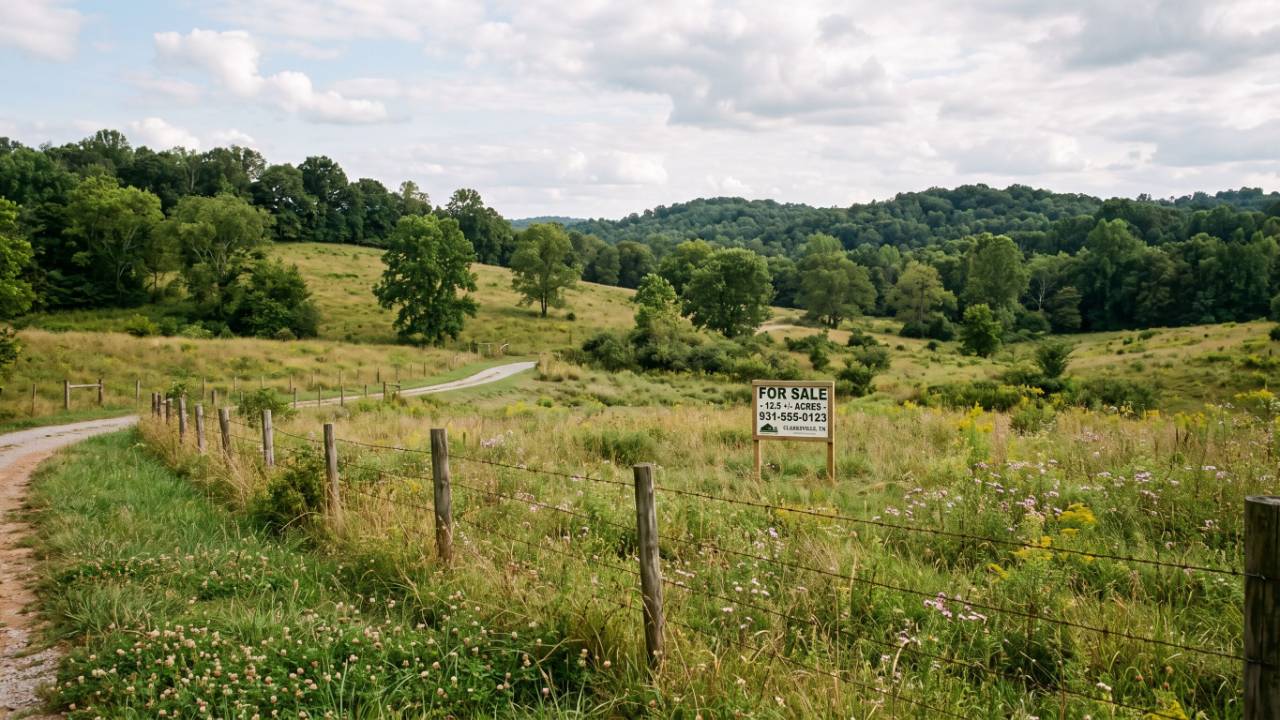
How do I buy land in Clarksville, TN to build a home? It's a question more buyers in the Sango area and 37043 corridor are asking in 2026, and for good reason. Existing inventory on the south side stays competitive, and many buyers are turning to vacant land as a way to get exactly the home they want in a location they've already chosen. That's a legitimate strategy, and it works, but only when the due diligence is done right.
Buying land in Clarksville, TN to build a home is genuinely more complex than buying an existing property. There are more moving parts, more offices to contact, and more ways to end up owning a lot that looks perfect on paper but fails a building inspection before the first shovel breaks ground. I've watched buyers fall in love with a parcel on Zillow, make an offer, and discover during due diligence that it can't support a septic system or sits in a flood zone that restricts where the house can sit. Getting ahead of those problems is what this guide is for.
This article walks through six core areas every Clarksville land buyer needs to understand before signing a contract: finding a genuinely buildable lot, navigating local zoning and land rules, evaluating soil and site conditions, confirming utility access, securing the right financing, and running the pre-closing checklist that keeps your project on track. Every one of these has a real cost attached to skipping it, and the best buyers in this market run them simultaneously rather than in sequence.
How do I buy land in Clarksville, TN to build a home, finding a buildable lot
Most buyers start their land search on Zillow, Realtor.com, or land-specific platforms like LandWatch or Land.com. Those are fine starting points. But a listed lot and a buildable lot are not always the same thing, and that gap is where buyers lose money. The MLS shows what's for sale; it doesn't tell you whether the lot has sewer access, whether it's in a flood zone, or whether the soil will support a conventional septic system.
In the Sango area and 37043 corridor, vacant residential lots have been active in 2026, with prices ranging from around $40,000 on the low end to $260,000 or more for well-located subdivision lots. Recent sold comps include a Fawn Drive lot at $227,760 in July 2026, a Circle Drive parcel at $50,000, and a Sango Road lot at $40,000 (based on Montgomery County deed records and 2026 MLS data). That range reflects real differences in infrastructure, location, and buildability, not just size. A $40,000 lot and a $200,000 lot in the same zip code can represent very different development scenarios.
Working with a local agent who knows south Clarksville's infrastructure makes a meaningful difference here. At Deana Watson South Clarksville Real Estate, lot evaluation is part of the process before any offer gets written. That means identifying which parcels in the 37043 corridor have utility lines running adjacent to the street, which lots have been sitting on the market for a reason, and which sellers are motivated to negotiate. That knowledge isn't something a property search tool delivers.
What "buildable" actually means for a Clarksville lot
A lot is genuinely buildable when it has the correct zoning designation, either sewer access or confirmed septic feasibility, no flood designation that blocks construction, and conforming lot dimensions for the zoning district. A lot can satisfy every visible requirement and still fail one of these criteria. Septic feasibility and floodplain status catch buyers off guard most often, septic because the soil evaluation doesn't happen until after an offer is made, and floodplain status because a parcel can sit partially in a flood zone without that being obvious from a standard listing description. Both issues are resolvable with the right due diligence, but neither can be addressed after closing.
What zoning and local land rules mean for your build
Three separate offices govern what you can build in Clarksville and Montgomery County, and buyers commonly make the mistake of assuming one office handles all three. They don't. The Clarksville-Montgomery County Regional Planning Commission (CMCRPC) handles zoning questions, including rezoning requests and zoning district determinations. You can reach them at 931-645-7448. Montgomery County Building and Codes, located at 350 Pageant Lane, Suite 309, handles building and plumbing permits at 931-648-5718. And TDEC handles septic permits at 615-687-7000. Plan on calling all three before making any offer on a lot without public sewer access.
Zoning district minimums in the Clarksville-Montgomery County area vary significantly depending on which jurisdiction your parcel falls under. In unincorporated Montgomery County, the R-1 residential district requires a minimum of 6,000 square feet, while E-1 estate zoning requires 25,000 square feet, and some agricultural designations require 30,000 square feet or more. The city of Clarksville uses a different district structure with different minimums, some city R-1 tables show higher thresholds, so confirming whether your parcel is within city limits or in the unincorporated county is the first zoning question to resolve. Contact the CMCRPC directly at 931-645-7448 to get the specific district designation and minimum requirements for any parcel you're considering.
HOA covenants and deed restrictions: the rules zoning doesn't cover
In many south Clarksville subdivisions and planned communities, private deed restrictions and HOA covenants govern things zoning never touches: minimum square footage, architectural style, approved exterior materials, outbuilding restrictions, and fence rules. These are recorded with the county, enforced privately, and can be far stricter than any government regulation. A covenant that requires a minimum 2,500-square-foot home or prohibits certain roof materials will affect your build plans regardless of what the zoning allows. Pull and read all recorded covenants on any parcel before removing a financing contingency.
Floodplain maps and setback requirements that affect what you can build
A parcel's FEMA flood zone designation affects more than just flood insurance. It controls where the house pad can sit on the lot, where the septic field can be placed, and what foundation type is required. Setbacks from property lines, roads, streams, and other features further shrink the usable footprint of a lot that might look perfectly sized on a plat map. A narrow lot in a marginal flood zone with front and rear setbacks combined can leave very little room to build the home you actually want.
Why soil testing and site conditions can make or break a lot purchase
This is the step most buyers skip and later regret. For any lot without public sewer access, TDEC requires a soil evaluation and may require a percolation test to determine whether the soil can support an approved conventional septic system. Per TDEC's Design Criteria for Sewage Disposal Systems, soil absorption rates of 10 to 75 minutes per inch are generally acceptable for a conventional system. Soils absorbing slower than 75 minutes per inch, or sites with wetness problems, slopes over 30%, or insufficient soil depth, can result in outright denial of a septic permit.
Some lots in rural pockets of Montgomery County or on the outer edges of south Clarksville are listed at attractive prices precisely because the soil won't support a standard system. That doesn't make them worthless, but it means you're looking at an alternative system, which adds cost and complexity. Order the soil evaluation before removing financing contingencies, not after closing. TDEC requires an approved soil consultant to complete the evaluation using a high or extra-high intensity soil map.
Site prep costs in Clarksville: what to budget before breaking ground
Raw land listings rarely reflect the true cost of making a parcel ready to build. Clearing trees, grading for drainage, removing rock, and building an access road can add substantially to your project budget before construction starts, figures commonly cited by Clarksville-area grading contractors range from $20,000 to $60,000 or more depending on site conditions, though your actual cost will depend on the specific parcel. Always get a site prep estimate from a local grading contractor before finalizing your budget. Larger acreage tracts listed at an attractive per-acre price often carry high site prep costs that erase the apparent savings. Current active Montgomery County listings show some tracts around $16,000 to $25,000 per acre, but the per-acre price is only part of the picture.
How utility access shapes your lot's true buildability
Utility access must be verified for every parcel individually. Never assume service is available because a lot is in a developed area. In Clarksville, Clarksville Gas and Water serves water and sewer within city limits and much of Montgomery County, with service extending into south Clarksville corridors including Rossview Road, Trenton Road, and Dunbar Cave Road. CDE Lightband handles electricity and broadband within city limits. For county areas outside city service, CEMC often covers electric service, and utility districts like East Montgomery or Cunningham Utility District serve water in some pockets.
The service area check process is straightforward: call the utility, provide the parcel address or APN, and confirm whether service is available at the lot line or requires a line extension. A line extension can cost significantly more than the tap fee alone. For Clarksville Gas and Water, new gas service connections include a $25 application fee plus a connection fee and a $150 tapping fee covering the first 150 feet; footage beyond that is billed at $2 per foot (per the CGW fee schedule, confirm current rates directly with the utility at 931-645-7400 before closing). Get a service confirmation and cost estimate from each provider before you close on any vacant lot in Clarksville, TN.
For buyers working remotely, broadband access is a non-negotiable evaluation point. CDE Lightband offers fiber within city-served areas. Outer county lots may be limited to fixed wireless or slower options. For a buyer splitting time between home and a remote work setup, this can determine which parcels are actually viable.
Financing your land purchase and construction in Tennessee
A land loan and a construction loan are two different products, and most buyers need both at different stages of this process. A land loan is used to purchase the vacant parcel and can be held before build plans exist. A construction loan funds the actual build and typically requires approved plans, a licensed builder, a detailed timeline, and a draw schedule. A construction-to-permanent loan combines both into a single closing, which reduces paperwork and locks the rate for both the build phase and the long-term mortgage.
Land loans typically require a higher down payment than a conventional home purchase, often 20 to 30 percent, because lenders treat raw land as higher-risk collateral. If you already own the lot free and clear, that equity often counts toward the down payment requirement on a construction loan. Local lenders in Clarksville offering these products include Tennessee Valley Federal Credit Union (TVFCU), which offers construction-to-permanent loans and separate land loans; First National Bank of Tennessee and FirstBank, both offering land and lot loans; and Rural 1st, which offers a one-time close construction loan structure. Contact each lender directly to confirm current program availability, geographic restrictions, and one-time-close eligibility for your specific project.
Before a construction loan funds, lenders require a signed builder contract, approved plans and specs, a detailed budget, an appraisal based on the as-completed value, proof of income and assets, and builders risk insurance. Having those documents organized before you apply shortens the timeline considerably.
From signed contract to breaking ground: your practical next steps
The due diligence window between going under contract and closing is where land purchases succeed or fail. Experienced buyers in Clarksville run these steps simultaneously rather than one at a time to avoid delays. The sequence is: verify zoning and confirm the lot meets dimensional minimums, pull and review all recorded deed restrictions and covenants, order the soil evaluation and perc test if public sewer is unavailable, confirm utility availability at the lot line for water, sewer, electric, and broadband, review the parcel's FEMA floodplain status, and order a boundary survey.
Skipping any of these steps carries a specific cost. Skip the soil evaluation and you might close on a lot that can't get a septic permit. Skip the deed restriction review and you might design a home the covenant won't allow. Skip the floodplain check and you might discover your build site is more constrained than the lot size suggests. None of these are theoretical: they happen in Clarksville, and they happen to buyers who moved too fast.
Building your team before you need them
The professionals you need for a land purchase should be identified before you close, not after. Line up a licensed surveyor for the boundary survey, a TDEC-approved soil consultant for the site evaluation, a local builder who works with owner-provided lots, and a lender already familiar with construction financing in Tennessee. Having these contacts ready shortens the gap between closing on the land and actually breaking ground. The buyers who move fastest after closing are the ones who built their team during due diligence.
How do I buy land in Clarksville, TN to build a home, making the right lot choice
Buying land in Clarksville, TN to build a home is a realistic and rewarding path, but the due diligence has to happen before the contract is signed, not after. The six areas this guide covered, lot selection and location, zoning and land use rules, soil and site conditions, utility access, financing structure, and the pre-closing checklist, aren't steps you can skip or reorder without consequence. Each one protects you from a specific category of costly mistake.
South Clarksville, particularly the Sango area and 37043 corridor, offers strong appeal for buyers looking to build: established schools, existing infrastructure, and consistent buyer demand all contribute to the area's track record. Active 2026 listings and recent sold comps in this corridor reflect that ongoing interest. But evaluating land well requires local knowledge that goes beyond a property search, knowing which streets have sewer at the line, which parcels have been listed for a reason, and which pockets of 37043 tend to hold their value over time.
If you're asking how do I buy land in Clarksville, TN to build a home and want a second opinion before making an offer, reach out to me at Deana Watson South Clarksville Real Estate. I help buyers evaluate parcels in the 37043 corridor for long-term fit, contact me for a free lot evaluation before you commit. Getting the lot right is the decision that determines everything that follows.